Walking the Cultural Trail of Ganpo, Learning through Practice
Walking the Cultural Trail of Ganpo, Learning through Practice
Students of the School of Agriculture, Qingdao Hengxing University of Science and Technology Visit Yimen Chen in Jiangxi for an In-depth Study Tour
"Read ten thousand books, travel ten thousand miles." To break down the walls of the classroom, cultivate a deep appreciation of traditional culture, experience the power of family heritage, and broaden students' humanistic horizons, students of the School of Agriculture at Qingdao Hengxing University of Science and Technology recently traveled to Jiangxi for an immersive cultural study tour. Focusing on the family traditions of Yimen Chen, traditional intangible cultural heritage crafts, and the natural and cultural landscapes of Ganpo, the tour enabled students to learn as they walked, reflect as they experienced, and grow as they explored. They returned with rich rewards and lasting memories.
Tracing Yimen Chen: Carrying Forward a Thousand Years of Family Values
Jiangzhou Yimen Chen, located in De'an, Jiujiang, Jiangxi Province, is a brilliant gem of Chinese family culture, long celebrated as "the First Family under Heaven." For generations, the Chen clan lived together in harmony, sustaining a rigorous family code, wholesome traditions, and a spirit of unity and benevolence that have endured to this day. It has become a living embodiment of fine traditional Chinese culture.
During the study tour, students visited the China Family Values Park at Yimen Chen to explore the secrets of this millennium-old lineage in an immersive setting. Guided carefully by the docent, they studied the transmitted family instructions, including the Thirty-three Articles of the Family Law, the Sixteen Rules of the Family Code, and the Twelve Norms of Family Conduct. They reflected on the family governance ideals of "honoring filial piety and fraternal respect, living in harmony with neighbors, studying the classics, and upholding loyalty and good faith," and gained a deeper understanding of the selfless spirit captured in "no private property within the household and no separate kitchens," as well as the core value of family unity.
The memorial archway at Yimen Chen in De'an, Jiangxi
● ● ●
From the flourishing of the clan in the Tang and Song dynasties to the tradition of farming and study passed down through generations and the emphasis on education, and further to the family-and-nation ethos of loyalty, filial piety, benevolence, righteousness, and harmonious coexistence, the thousand-year heritage of Yimen Chen deeply touched every student. Through reciting family precepts, listening to historical anecdotes, and examining archival materials, they came to appreciate the profound meanings of unity and cooperation, self-cultivation and moral integrity, and earnest practice toward goodness. They learned that harmony in a small family is the foundation of a thriving larger community, and that individual responsibility brings honor to the collective, laying a solid spiritual foundation for their future studies, lives, and teamwork.
Practicing Intangible Heritage: Experiencing the Beauty of Traditional Craftsmanship
Cultural heritage is sustained not only through listening and reflection, but also through hands-on practice and personal engagement. To experience the unique charm of China's traditional folk culture, the study group took part in a number of intangible-heritage craft workshops, bringing tradition to life at their fingertips.
In the kite-making workshop, students built the frames, outlined the patterns, and painted the decorations themselves, carrying out every step with meticulous care. From clumsy first attempts to confident execution, they discussed techniques and helped one another, completing their own distinctive kites through collaboration. A paper kite carries the romance of traditional culture as well as the strength of teamwork, allowing students to feel both the enjoyment and the craftsmanship of folk traditions through hands-on creation.
Students painting and decorating their handmade kites
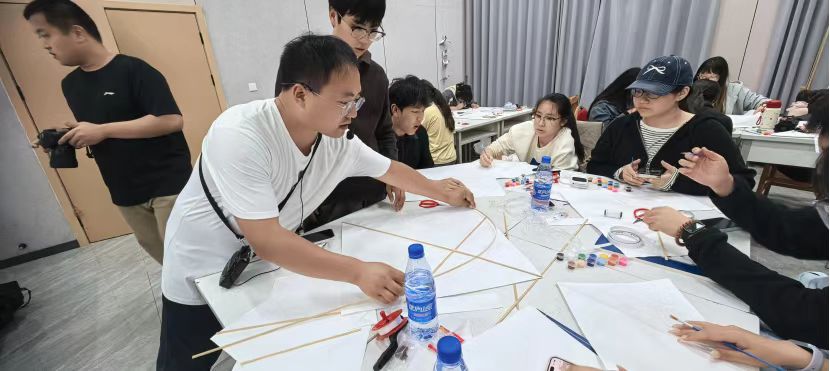
Colorful handprints painted on the kites
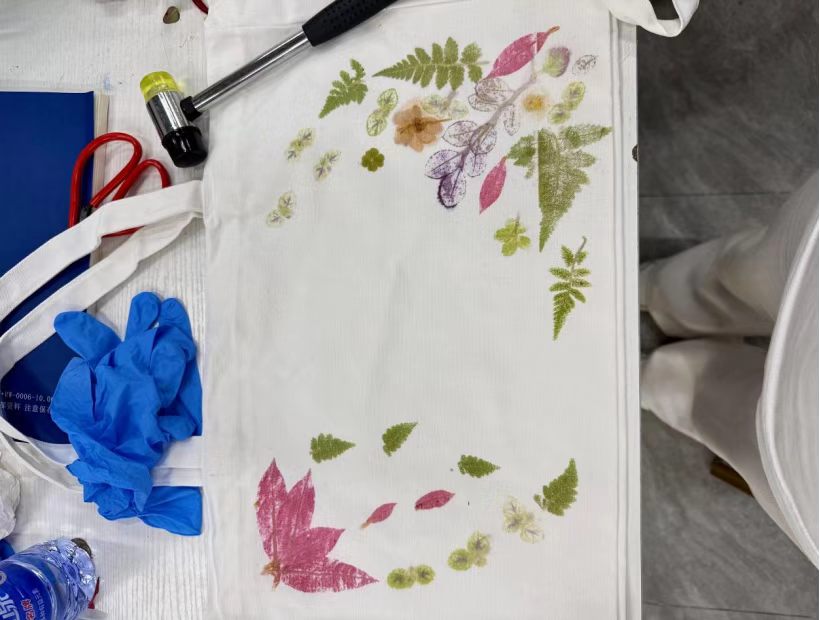
In the plant-dyeing class, students used natural grasses and foliage as material and skillful hands as brushes, preserving the natural textures of flowers and leaves on fabric through traditional dyeing techniques. Pressing, beating, and fixing the colors, every step demanded patience and concentration. Unique and elegantly composed pieces emerged one after another, giving students a genuine sense of how ancient craftsmanship blends with the beauty of nature.
A student pounding leaves onto fabric in the plant-dyeing workshop
Fabric pieces dyed with natural leaf and flower imprints
The mugwort hammer workshop was both delightful and meaningful. As a traditional medicinal herb, mugwort carries the health wisdom and humanistic spirit of the ancients. Students carefully selected the mugwort, shaped it, and wrapped and secured it to make their own hammers. Through this hands-on work, they not only learned about the herb's medicinal properties and the traditional culture of wellness, but also felt the warmth of traditional handicrafts in an immersive experience and appreciated the ancient wisdom of living in harmony with nature and cultivating one's character.
Exploring the Scenery of Ganpo: Immersed in Nature and Culture
The Jiangxi study tour combined in-depth cultural learning with sightseeing. Alongside their immersive study of family traditions and hands-on heritage experiences, students visited landmark cultural and natural sites including the Yimen Chen scenic area, Mount Lu, and Nanchang, taking in the distinctive charm of the Ganpo landscape from every angle.
At the Yimen Chen scenic area, gray bricks and dark tiles, ancient ancestral halls and old residences, and thousand-year-old trees form a harmonious scene. The rustic courtyard layout and weighty stone inscriptions reveal the vicissitudes and cultural accumulation of a millennium-old family, immersing students in the enduring charm of its time-honored family traditions.
A handmade mugwort hammer with a red woven handle
Ascending Mount Lu, students were greeted by rolling seas of clouds, layered green peaks, cascading springs, and waterfalls, with superb scenery at every turn. The spectacle of "the most beautiful mountain under heaven" unfolded before them. Walking among the hills, they took in the beauty of nature, relaxed body and mind, broadened their horizons, and developed a deeper sense of natural ecology. This resonates closely with the original mission of students of the School of Agriculture: to deepen their expertise in agriculture and forestry, revere nature, and protect ecosystems.
An ancient tree displayed in the exhibition hall of the Yimen Chen scenic area
Waterfalls cascading down the rocky cliffs of Mount Lu
Students posing for a group photo in front of the Mount Lu waterfalls
In Nanchang, a city where revolutionary heritage meets modern vitality, students encountered profound humanistic history and a red revolutionary legacy. Strolling through its streets and lanes, they traced the cultural threads of Ganpo and felt the city's blend of ancient and modern charm. The walk broadened their humanistic perspective, deepened their patriotism, and gave them a vivid sense of the breadth, depth, and long continuity of Chinese culture.
Learning through Practice: Empowering Youthful Growth
Only by integrating knowledge and action can one reach one's goal. The study tour to Yimen Chen in Jiangxi was a walking ideological and political class, a vivid cultural lesson, and a hands-on practical course. From the spiritual nourishment of a thousand years of family traditions to the craftsmanship of intangible heritage, from the natural immersion of mountains and waters to the deep cultivation of humanistic heritage, every stage of the journey and every experience benefited the students greatly.
Students in the field during the study tour in Jiangxi
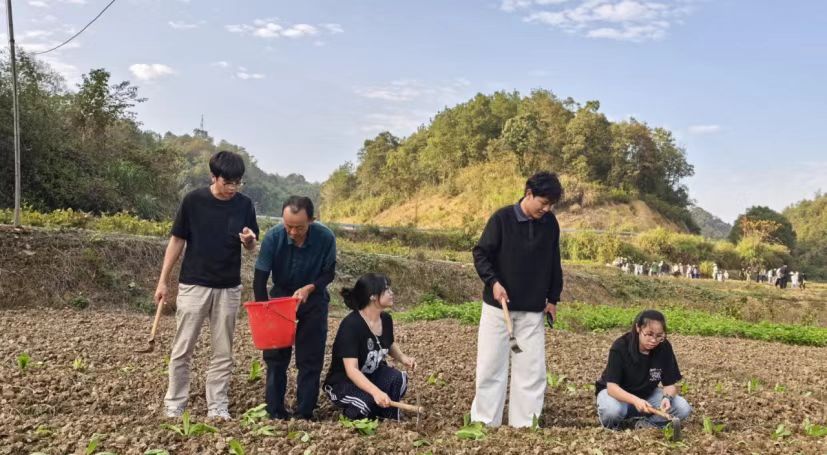
Through this study tour, students of the School of Agriculture at Qingdao Hengxing University of Science and Technology not only gained a deeper understanding of China's fine traditional family culture and intangible heritage, but also honed their patience, concentration, and teamwork. The spirit of unity and harmony, self-cultivation and moral integrity, and earnest progress has taken root in their hearts and found expression in their actions.
Looking ahead, the School of Agriculture will continue to deepen practice-based education and regularly organize study and field activities. By guiding students out of the classroom, into nature, and into culture, the school helps them build character and enhance their abilities through the unity of knowledge and action, carrying forward traditional culture with youthful energy and advancing toward new horizons with steadfast steps.